

Rafael — The Man with the Wheelbarrow
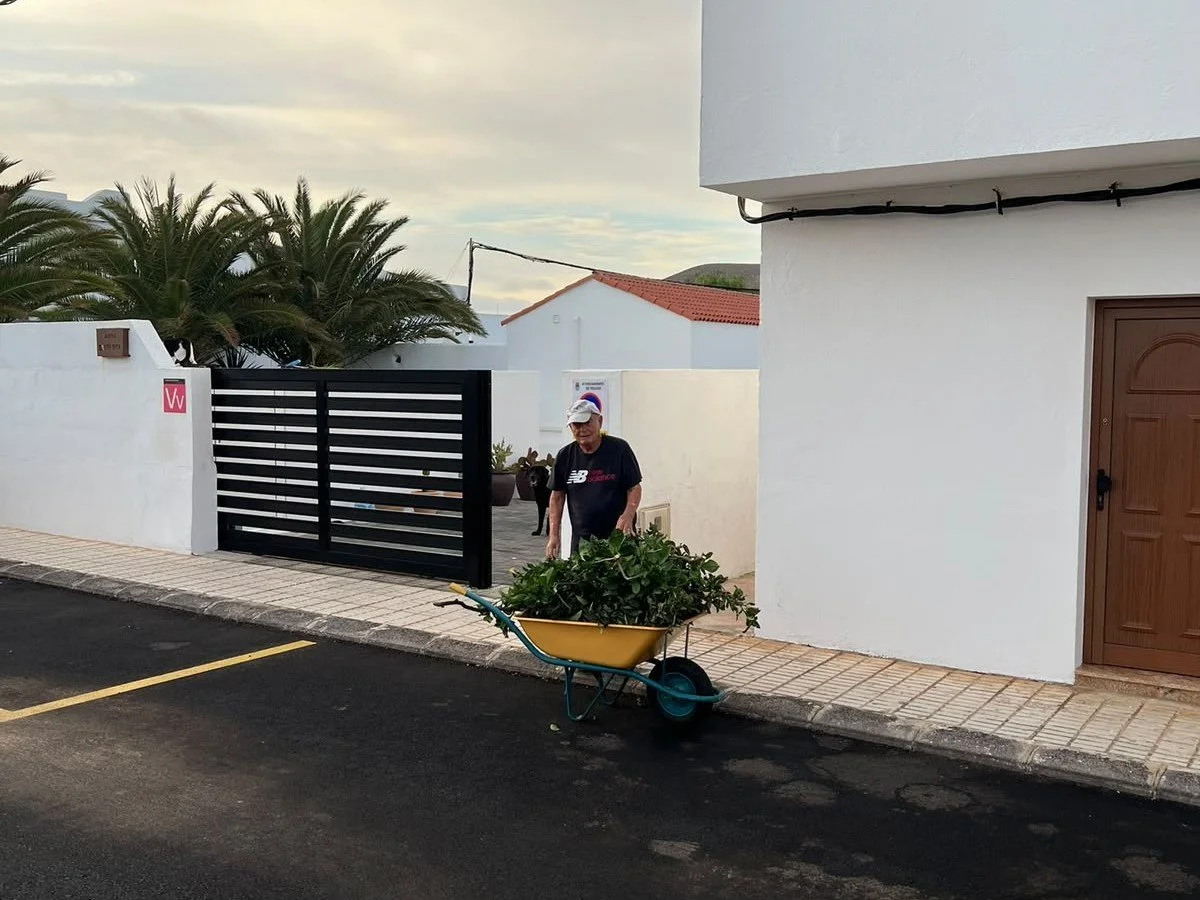
The Man with the Wheelbarrow
We bought our house in Guatiza four years ago, but it was only a little over three years ago that we moved to Lanzarote.
At the time, we had no idea the house had once belonged to the village blacksmith.
We didn't buy it from him, of course. The previous owners were English, and I suspect they knew as little about the house's history as we did.
Rafael, our next-door neighbour, was one of the first people we met after moving to Guatiza. In fact, I think we met him on our very first day.
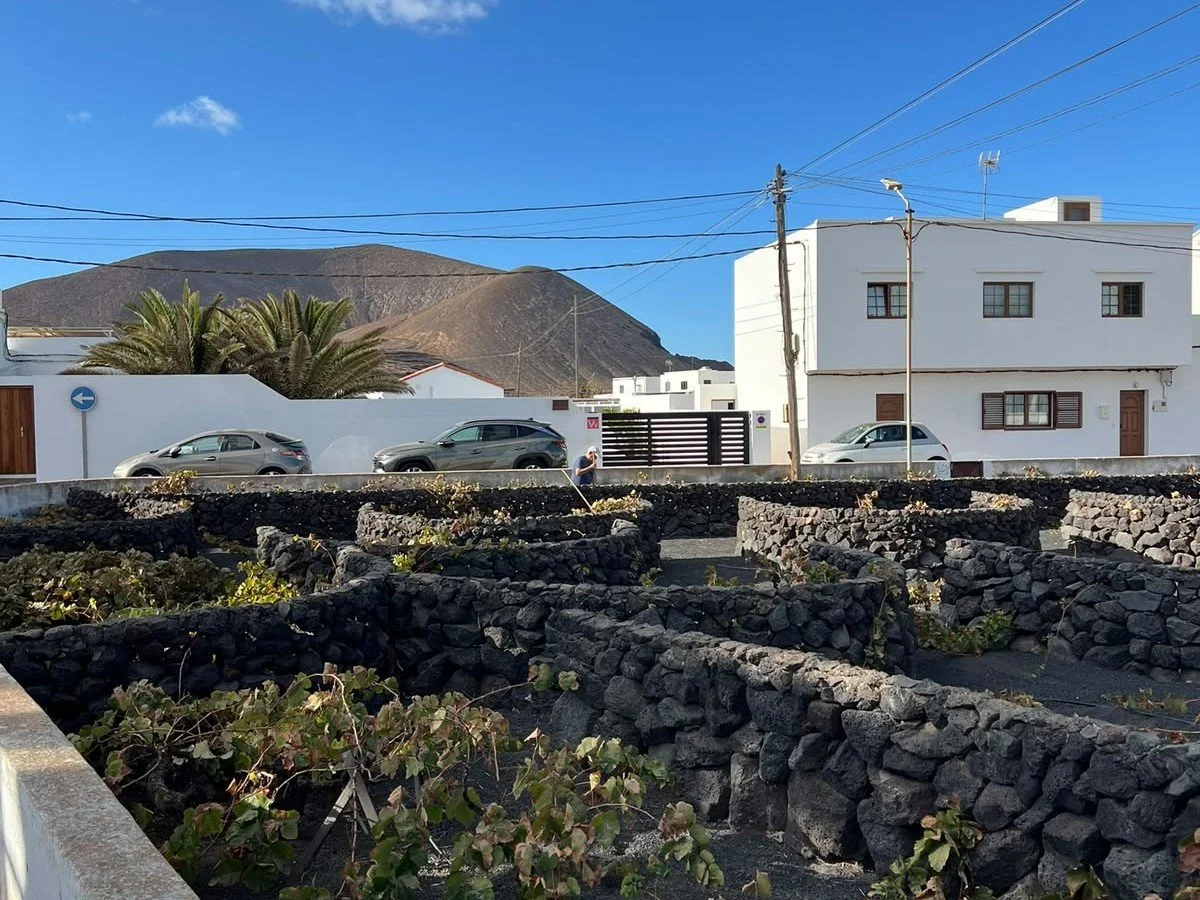
Rafael was there from the beginning.
We got to know our other neighbours gradually, over the following weeks and months. But Rafael was there from the beginning.
Buenos días. ¿Qué tal?
A few words, a smile, sometimes a little conversation. Nothing extraordinary. Just the sort of small exchanges from which neighbourly relationships grow.
But after a while, I began noticing something about him.
Almost every day, Rafael pushes his wheelbarrow towards his little plot of land.
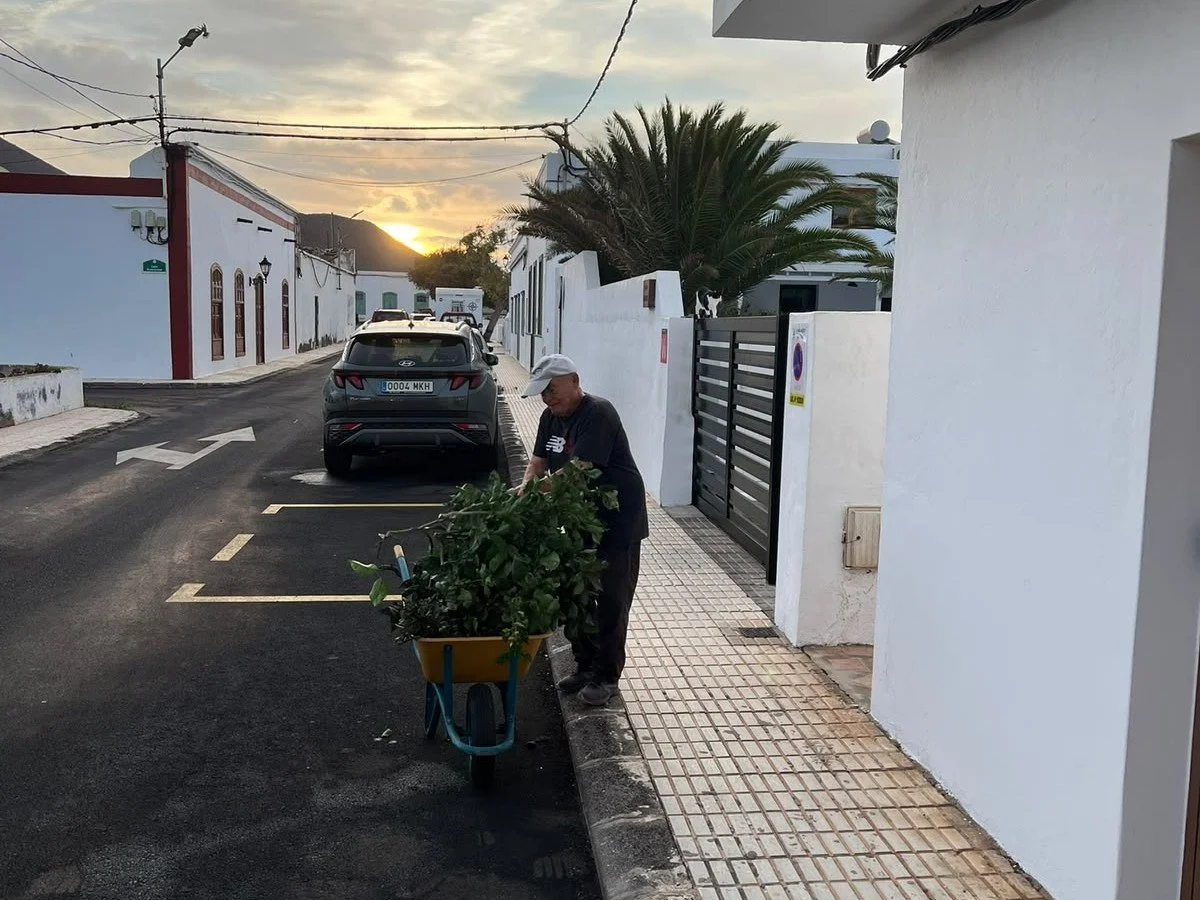
He is always busy.
Sometimes he tends his vines. Sometimes he plants vegetables, clears something, repairs something, or simply finds another job that needs doing.
He is always busy.
I began to wonder where all that energy came from.
I have never heard him complain. Not about his age, not about the work, not about the weather. He simply gets on with whatever needs doing.
And he certainly had every reason to complain about us.
For almost two years, we were renovating our house. Anyone who has lived through a serious renovation knows what that means: dust, noise, deliveries, builders and seemingly endless work.
At one point, a drilling machine spent three consecutive days boring a forty-metre-deep hole into the ground for our wastewater system.
Three days of drilling.
Rafael lives right next door.
He never complained.
Instead, he brought us fruit from his garden. Vegetables he had grown himself. There was always a friendly greeting, a kind word, a moment to talk.
He never made a fuss about any of it.
That is simply Rafael.
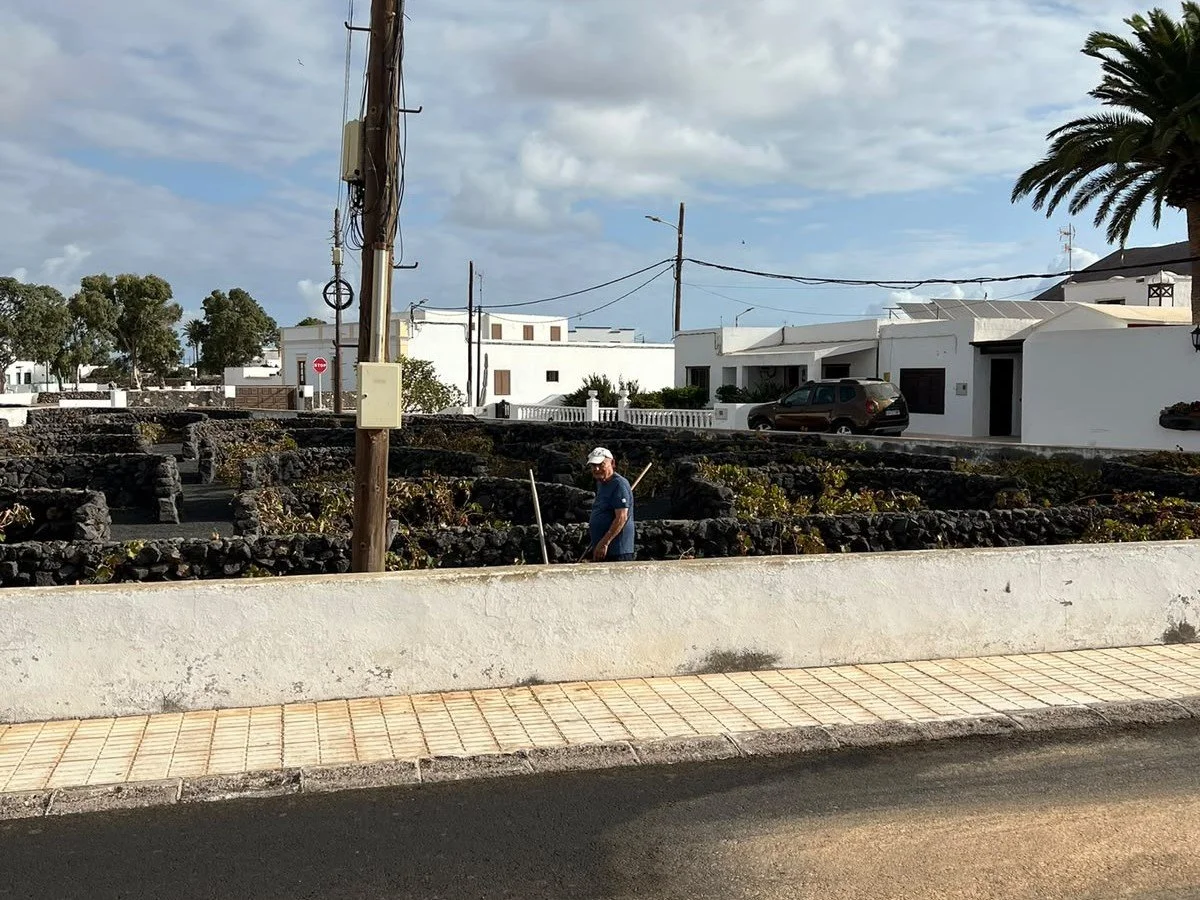
And slowly, I became curious.
Who was this man? What had he lived through? Where did his energy come from? What made him approach life with such apparent ease?
I've always been interested in people whose stories rarely make it into books. Not necessarily famous people, or people who have achieved something the world considers remarkable. Just ordinary people who have lived long enough to have something worth saying.
Eventually, I decided to do something I had never done before.
I asked Rafael if I could interview him.
I'm not a journalist. I had never interviewed anyone in my life, and I wasn't entirely sure I knew how.
But I wanted to listen.
Not to pay him some grand tribute or turn him into a local legend. I suspect he would find that rather amusing.
I wanted to understand him a little better. And perhaps, in my own way, to thank him for the fruit and vegetables, for his patience during our renovation, for the countless buenos días, and for the kindness he has shown us since we arrived.
I didn't know that our conversation would take me back more than seventy years.
To a very different Lanzarote.
And to a twelve-year-old boy who loved mathematics but had to go to work.
Two hundred pesetas
Rafael was born in Arrecife in 1942, three years after the Spanish Civil War ended.
There were six children in the family. Four girls and two boys. His father was a municipal policeman, his mother looked after the household, and money had to stretch a long way.
At twelve, Rafael began working in a clothing shop that also had a petrol pump.
He earned 200 pesetas a month.
When he tells me this, I ask how much that would be in euros.
"A euro and a little more," he replies.
Technically, he's right. At the fixed conversion rate eventually used when Spain adopted the euro, 200 pesetas amount to about €1.20.
Of course, that tells us almost nothing about what the money could buy in the 1950s. But hearing the figure still makes me stop.
Twelve years old.
I try to imagine him in the morning, perhaps wishing he could stay in bed a little longer. Perhaps thinking about the other children, the games he might have played, the lessons he might have attended.
We don't know what went through his mind.
We know only that he went to work.
Later, his father opened a small bar near the bus station in Arrecife. Rafael joined the family business and would spend more than fifty years working behind its counter.
He laughs when he remembers how small he was.
He could barely reach the bar.
His mother prepared little tapas. His father helped when he wasn't on police duty, sometimes taking over so Rafael could go out or play football.
But the hours were long.
As he grew older, Rafael would get up at five in the morning. Some days he worked until two in the afternoon. Others, when there was nobody to relieve him, he stayed until nine at night.
And this was not an unusual working day. It was his life.
When I ask him how he became so accustomed to working, he doesn't offer an elaborate explanation.
"It's just the way I am."
Then he adds that he has been working since he was twelve.
As though that explains everything.
Perhaps it does.
When people had very little, but shared what they had
The Lanzarote Rafael remembers from childhood is difficult to reconcile with the island we know today.
There were ration cards. Food and basic goods were scarce. Electricity was available only during certain hours, generally in the evening.
Refrigerators were not part of ordinary household life.
He remembers bars cooling their drinks in large containers filled with ice delivered from a factory. Meat was preserved in salt. Cooking was done over simple fires, later on wick stoves, and eventually with gas.
Even fuel could disappear.
If the ship bringing supplies from Las Palmas was delayed by bad weather, Lanzarote might simply have to manage without it.
Water was another constant concern.
Rain was scarce, wells and cisterns mattered enormously, and every drop had a purpose. People collected what they could and learned to grow crops with remarkably little.
Yet when Rafael talks about those years, he doesn't speak only about what was missing.
He remembers the people.
And this is where our conversation becomes particularly interesting to me.
He tells me about a time when neighbours helped one another without expecting payment for every hour of work.
In the countryside, there was a tradition called peonadas.
If someone needed help planting onions, neighbours would come. Today they worked on your land; tomorrow everyone would help someone else. The next day, perhaps another family.
The work moved from one household to another.
There might be a shared meal afterwards, perhaps sancocho or tollo, some cheese and a few glasses of wine.
It was hard work, but also a way of belonging.
And there was something else Rafael remembers: people could rely on one another without feeling entitled to interfere in each other's lives.
They respected boundaries.
You didn't need to know every detail of your neighbour's private affairs to be there when help was needed.
That distinction stays with me.
Because we sometimes confuse community with constant involvement in other people's lives. Rafael describes something quieter: knowing when to offer a hand, and when to leave someone alone.
Perhaps that is why I think of his patience during our renovation.
He didn't need to become our best friend to be a good neighbour.
He simply was one.
The boy who wanted to learn
Of everything Rafael tells me, there is one thing that seems to carry a particular weight.
He loved school.
Especially mathematics.
He remembers being an excellent pupil, earning the highest marks. More than seventy years later, he still speaks about numbers with the enthusiasm of someone who genuinely enjoys them.
He also remembers his teacher.
Don Manuel, a man from Galicia, taught him reading, writing and the four basic operations of arithmetic.
Rafael remembers his full name, although I cannot be certain I have transcribed it correctly.
Think about that for a moment.
A man of eighty-four remembering the name of the teacher who taught him when he was a child.
He speaks about Don Manuel with unmistakable affection.
He also remembers a lesson that stayed with him throughout his life: human beings should learn from ants, which gather food while they can so they have something for the winter.
It is a simple lesson, perhaps. But we will discover later just how seriously Rafael took it.
School ended when he was twelve.
Not because he lacked ability.
Not because he had lost interest.
He had to work.
But his curiosity didn't disappear.
After work, he attended additional lessons with a young woman whose family knew his father. She was studying to become a teacher and helped him with mathematics and other subjects.
She didn't charge him.
She taught him out of friendship.
Once again, the conversation returns to that vanished world of mutual help.
I imagine Rafael after a long working day, sitting down to study when he could have been doing almost anything else.
Nobody was forcing him to take those lessons.
He wanted to learn.
And he never quite stopped wanting.
Towards the end of our conversation, I ask whether there is anything in his life he regrets.
His answer is immediate.
Not having been able to continue studying.
Especially mathematics.
He still enjoys calculations. He talks about percentages, numbers, managing money. You can hear the pleasure in his voice.
And I find myself wondering what might have happened if that twelve-year-old boy had been born in different circumstances.
What if someone had told him that his talent mattered more than the immediate need to earn money?
What if he had been able to continue his education?
Would he have become an engineer? A mathematician? A teacher?
We will never know.
And that is precisely what troubles me about lost opportunities.
We tend to think of them as things that simply didn't happen. But sometimes they are entire possible lives that never had the chance to begin.
Rafael doesn't dwell on these questions in the way I do.
Instead, he tells me about his son.
When he married Elena, who was a teacher, he made a decision. If they had a child, that child would study.
He was determined that his son would have the opportunity he himself had missed.
And his son did study.
He became an engineer.
When I ask Rafael whether he is proud of him, his answer leaves no room for doubt.
Very, very proud.
Later, when I ask what has mattered most in his life, he doesn't mention the bar, the money he earned or the property he acquired.
Being a father.
That is his answer.
And suddenly, the story of the boy who couldn't continue school feels a little less unfinished.
Not because his son somehow replaces the life Rafael might have lived.
But because Rafael found a way to give someone he loved the freedom he had been denied.
The university behind the bar
Perhaps Rafael's formal education ended at twelve.
But I am beginning to suspect that his education itself never really ended.
It simply changed location.
Instead of a classroom, there was the counter of a small bar near the bus station in Arrecife.
Instead of teachers, there were the people who came in after work.
Farmers. Men who knew the land, the seasons, the wind and the vines.
Rafael served drinks, carried food and cleared glasses.
And he listened.
The conversations turned to vineyards, to rain that might or might not arrive, to the right time to prune, to the strange ways in which volcanic soil holds moisture.
And to the moon.
Because even the moon had a place in the agricultural traditions of Lanzarote.
Rafael tells me that vines are traditionally pruned in February, during the waning moon — luna menguante.
It is a custom handed down through generations, rather than a rule he claims to have discovered scientifically.
He explains the importance of picón, or rofe, the dark volcanic gravel that helps conserve precious moisture in the soil.
He talks about zocos, the low stone walls built to shelter vines from the relentless wind.
And he knows about the tradition of opening young wine on 29 November, Saint Andrew's Day.
None of this came from an agricultural college.
When I ask him who taught him to make wine, his answer is wonderfully straightforward.
He asked older people.
They talked in the bar. He listened. He remembered. And later, he tried things for himself.
I love that.
The boy who had wanted so badly to remain in school had found another way to learn.
He was learning almost without realising it, while earning his living.
Knowledge passed from one generation to another, sometimes across a vineyard, sometimes over a glass of wine, and sometimes across the counter of a small bar in Arrecife.
And Rafael remembered.
Because he knew how to listen.
I find myself thinking of Vicenta, another woman whose story belongs to Otro Mundo.
She spoke about the importance of learning to listen and observe before trying to speak with understanding.
Two different people. Two different lives.
And yet something remarkably similar.
Perhaps that is one of the reasons I enjoy talking to Rafael so much.
When he speaks, I want to listen.
A man from Arrecife, learning from the land
Rafael is quick to tell me that he isn't a real farmer.
"I am from Arrecife," he insists.
He speaks with admiration about people who were born in the countryside, grew up working the land and understand it instinctively.
He considers himself an amateur.
Someone who simply enjoys keeping busy.
I find this modesty rather charming, particularly when he starts explaining everything he knows about his vines.
The land he now cultivates originally belonged to his father-in-law.
Over the years, Rafael had it transformed, paid for the stone walls and developed the vineyard.
Much of what he learned came from those conversations he had overheard decades earlier in the bar.
But he doesn't rely entirely on tradition.
He talks about cleanliness in winemaking, about transferring the wine to remove sediment, and about taking samples to a laboratory for analysis.
Old knowledge and modern methods sit quite comfortably together in his world.
This year, he harvested 450 kilograms of grapes.
From them, he made 300 litres of wine.
White wine and traditional rosé.
Three hundred litres.
I ask him whether he sells it.
No.
He makes it for himself.
For pleasure.
And I begin to understand something about the man I have been watching from my window for the past three years.
Almost every day, there he goes with his wheelbarrow.
Sometimes he is carrying tools. Sometimes he is heading off to tend the vines or plant a few onions, garlic bulbs or pumpkins.
There is always something to do.
And he is eighty-four.
Five in the morning
At one point, I ask Rafael why he continues working so much.
After all, he is retired. He tells me that he lives comfortably. He has no financial need to spend his days tending the land.
He could simply do nothing.
His answer makes me smile.
"Because otherwise I'd get bored."
That's it.
No speech about the dignity of labour. No grand theory of healthy ageing. No attempt to present himself as an example to younger generations.
He would get bored.
And he still gets up at five in the morning.
Just as he did during the years when he worked in the bar.
Although, strictly speaking, he reminds me that as a small boy he sometimes got up a little later, because his father opened the bar first.
I like that detail.
Even after so many decades, he wants to get the story right.
There is a remarkable difference between the work Rafael did as a young man and the work he does today.
Then, he worked because he had to.
Now, he works because he wants to.
He doesn't pretend that his little vineyard is a commercial enterprise. He doesn't claim to be an expert farmer. He plants a few things, looks after his vines and enjoys watching them grow.
And this year, he has 300 litres of wine waiting for him.
He tells me that he intends to drink it.
"If God gives me health."
I laugh.
After everything he has told me about hard work, thrift and responsibility, there is something wonderfully reassuring about a man who makes three hundred litres of wine and hopes to be around long enough to enjoy them.
Did people live better then?
There is a question I have been wanting to ask Rafael.
When he looks back at the Lanzarote of his childhood, does he think life was better?
His answer surprises me.
No.
Life today is better.
He doesn't hesitate.
He remembers too clearly what it meant to live without reliable electricity, without running water, without refrigerators, without the ordinary comforts we barely notice anymore.
He is not nostalgic for poverty.
But when I ask whether we have lost something along the way, his answer changes.
Friendship, he says.
The kind of friendship people once had.
He remembers neighbours who helped one another build roofs or plant crops. Families who visited each other without making elaborate arrangements. People who knew they could count on one another.
He remembers respect, too, although he doesn't pretend everything about the old days was better.
Children were expected to obey their parents. Sometimes, he acknowledges, that obedience came more from fear than affection.
The past was not some golden age.
It was simply different.
And perhaps that is what I appreciate most about Rafael's memories.
He can recognise the good in a world he would not necessarily want to return to.
I ask him why people have become more isolated.
He isn't sure.
Perhaps it is simply the way the world has evolved.
There is no elaborate social theory, no convenient culprit.
Just the observation of a man who has watched society change over eight decades.
We have gained comfort, convenience and possibilities that his parents could scarcely have imagined.
But somewhere along the way, perhaps we have become a little less willing to knock on a neighbour's door.
Or to open our own.
I think again about the peonadas.
And about a man who quietly brings us vegetables from his garden.
The bank pays me
There is another side to Rafael that I find fascinating.
His relationship with money.
He has a rule.
If you want to spend ten euros, you should have twenty.
He tells me he has never liked owing money. Every car he bought, he paid for outright.
Then he says something that makes me laugh.
"The bank pays me interest. I don't pay interest to the bank."
He is rather pleased with that.
Some people, he tells me, think he is stingy.
He disagrees.
He considers himself a good administrator.
And listening to him, I begin to see how closely this connects to the boy who loved mathematics and to Don Manuel's lesson about the ants.
Work while you can. Save something for the future. Don't spend what you don't have.
Of course, I don't think it would be fair to turn Rafael's approach into a universal financial prescription.
The world has changed. Housing costs, wages and opportunities are different. His circumstances were his own, and Elena's work as a teacher also contributed to their family's financial stability.
He acknowledges that.
But the underlying idea is interesting.
For Rafael, managing money seems to have been a way of preserving his independence.
He worked hard because he wanted to live well, not because he believed life should consist entirely of work.
And this is where we must be careful not to turn him into a saint.
Because Rafael was never a saint.
At least, not the solemn, self-denying kind.
He loved playing cards, sometimes for money.
He loved parties, dancing, going out with friends and flirting with girls.
He laughs as he remembers how difficult it once was to approach a young woman.
Sometimes, he admits, a little whisky helped him find the courage to dance.
He enjoyed himself.
And he doesn't seem remotely embarrassed about it.
Why should he be?
This is a man who worked extraordinarily long hours, but also found time for football, friends, cards and fun.
He understood responsibility.
But he also understood pleasure.
I think that is a much more interesting combination than any portrait of a man who spent eighty-four years doing everything correctly.
Rafael has lived.
And he is still enjoying it.
One last question
Towards the end of our conversation, I ask Rafael something slightly unusual.
If he could sit down with himself at the age of twenty, what would he say?
He has told me so much by now.
About the war's aftermath, the bar, his family, his teacher, the education he missed, the people who helped him, the vineyards, the money he earned and the life he built.
I wonder whether he will offer some profound piece of advice.
Perhaps something about working harder.
Or studying more.
Or avoiding mistakes.
But Rafael doesn't need much time to think.
"Vive la vida, pero sé responsable."
Live life, but be responsible.
It is so simple that I almost want to ask him to elaborate.
But perhaps there is nothing to elaborate.
A boy who went to work at twelve.
A man who spent more than fifty years behind a bar.
A father who made sure his son could study.
A neighbour who still gets up at five, pushes his wheelbarrow down the road and grows grapes for wine he has no intention of selling.
A man who enjoyed cards, parties, dancing and the company of other people.
Who saved his money without forgetting to spend some of it on living.
And who, at eighty-four, still hopes to enjoy another glass of his own wine.
If God gives him health.
The next time I see Rafael heading towards his vineyard with that wheelbarrow, I'll probably call out the same words I have been saying for more than three years.
Buenos días, Rafa. ¿Qué tal?
But I suspect I'll be looking at him a little differently.
And perhaps that was the point of asking him all those questions in the first place.
Not to discover an extraordinary man hidden behind an ordinary life.
But to discover how much there is to learn when we finally take the time to listen.
Vive la vida, pero sé responsable.
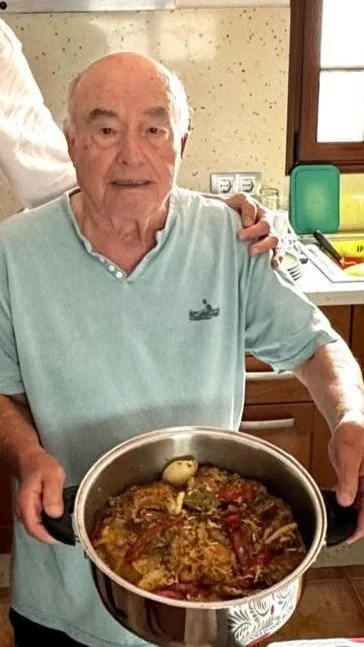
Rafa is an amazing cook