Otro Mundo es Posible
Fifteen years ago, on our very first evening in Lanzarote, we were convinced we were going to bed hungry.
Back then, travelling was different.
There was no Booking.com app in our pocket. No WhatsApp messages from hosts. No online check-in instructions. No emergency contact available at the touch of a screen.
We had a booking confirmation, a printed address and a rough idea of where we were going.
That was about it.
We had rented a small house by the ocean in Punta Mujeres, on the northern coast of Lanzarote. Long before Casitas Santa Rita existed, we were already drawn to quieter places. Resorts had never really appealed to us. We preferred small villages, local restaurants and the feeling of discovering a place rather than consuming it.
We arrived in the afternoon.
The house was locked.
There was no owner waiting for us. No phone number. No instructions. No way to get inside.
As we stood there wondering what to do, a neighbour who had apparently been watching us for some time walked over and said, as casually as if this happened every day:
"I have the key."
No questions.
No documents.
No booking reference.
No passport checks.
He simply opened the house and went on with his day.
Everything already felt different here.
That evening, after unpacking, we walked to nearby Arrieta looking for dinner. Having spent many holidays in mainland Spain, especially in Seville, we weren't worried. In our experience, restaurants came alive late in the evening.
Instead, one by one, we found every restaurant closed.
The kitchens were shut.
The lights were out.
The streets were quiet.
We had no food in the house and slowly accepted that our first night on Lanzarote might end without dinner.
Then we noticed a light.
Inside one restaurant, a woman was cleaning. Chairs were already on the tables. The floor had been washed. Clearly, the day was over.
Using our broken Spanish mixed with English, we tried to explain our situation.
"Solo pan y queso, por favor."
Just bread and cheese.
That would be enough.
The woman looked at us.
Then she smiled.
"Siéntense. Os hago una paella."
Sit down. I'll make you a paella.
We assumed she had some leftovers.
Instead, she handed us a bottle of wine and some cheese, returned to cleaning and occasionally disappeared into the kitchen.
About half an hour later she emerged carrying an entire paella pan.
A real paella.
Freshly made.
Prepared from scratch.
Then she added two bottles of wine and some grapes.
"We are closed," she explained in Spanish.
"Take it with you."
"We have already closed the till."
"Bring the pan back tomorrow."
"You can pay tomorrow."
Mañana.
We walked the two kilometres back to our house carrying a paella pan, wine and grapes, completely unable to believe what had just happened.
We had asked for bread and cheese.
Instead, we had been given kindness.
The woman's name was Loli.
Looking back, I sometimes wonder how we managed to communicate at all.
Loli spoke no English.
We spoke almost no Spanish.
There were no translation apps.
No AI assistants.
No phones translating conversations in real time.
Most of our conversations happened somewhere between Spanish, English, hand gestures, smiles and complete improvisation.
And somehow they always worked.
Not because we shared a language.
But because we shared something more important: trust, curiosity and a genuine interest in one another.
At the time, we had no plans to move to Lanzarote.
Not even remotely.
We simply kept coming back.
Once a year.
Then twice a year.
Every visit included a stop at Loli's restaurant.
Another meal.
Another conversation.
Another evening spent with her family.
Over time we got to know her children, her relatives and her friends.
Then something unexpected happened.
We started learning Spanish.
Not because we wanted to buy a house.
Not because we dreamed of moving to Lanzarote.
Not because it seemed useful.
We learned Spanish because we wanted to talk to our friends.
Years later we learned more about Loli's story.
About raising three children largely on her own after being left to carry the responsibility for an entire family.
About resilience, sacrifice and quiet strength.
Looking back, it makes that first evening even more extraordinary.
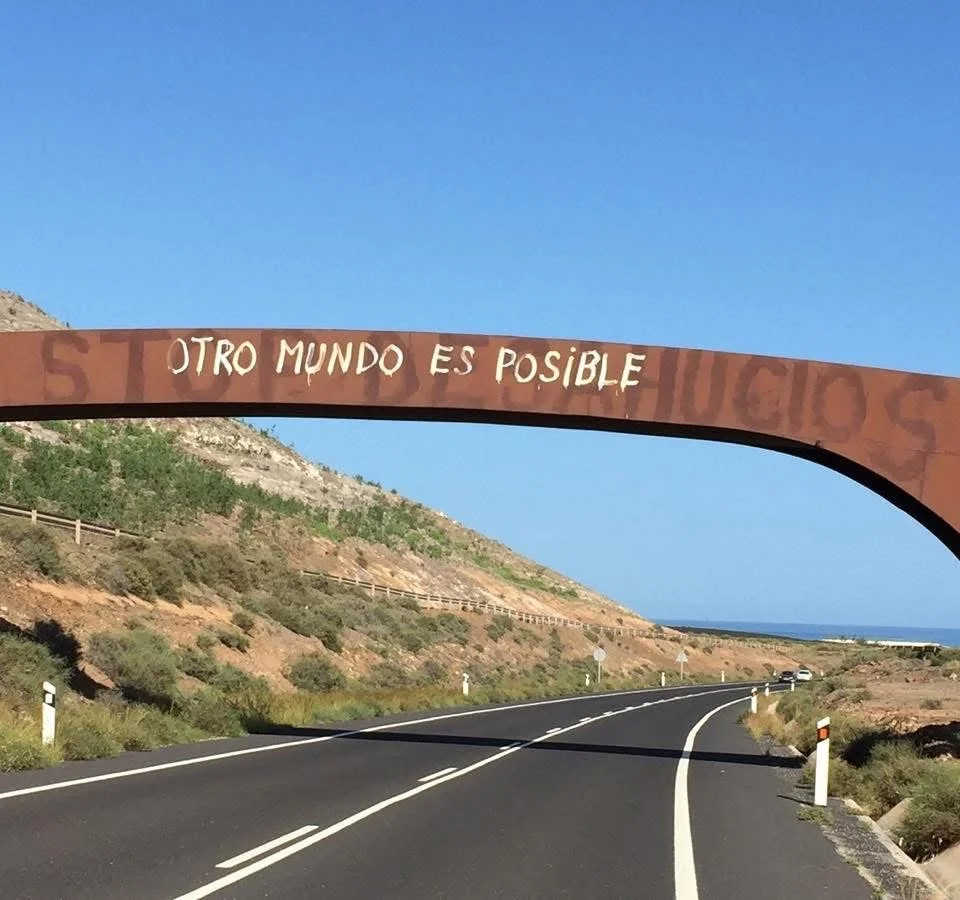
The following day, while exploring the island, we noticed a large message painted on a bridge crossing the road.
Today we know it was a bridge built for goats.
Back then, we had no idea.
We simply stopped the car because something about the words caught our attention.
The message read:
OTRO MUNDO ES POSIBLE
Another World is Possible.
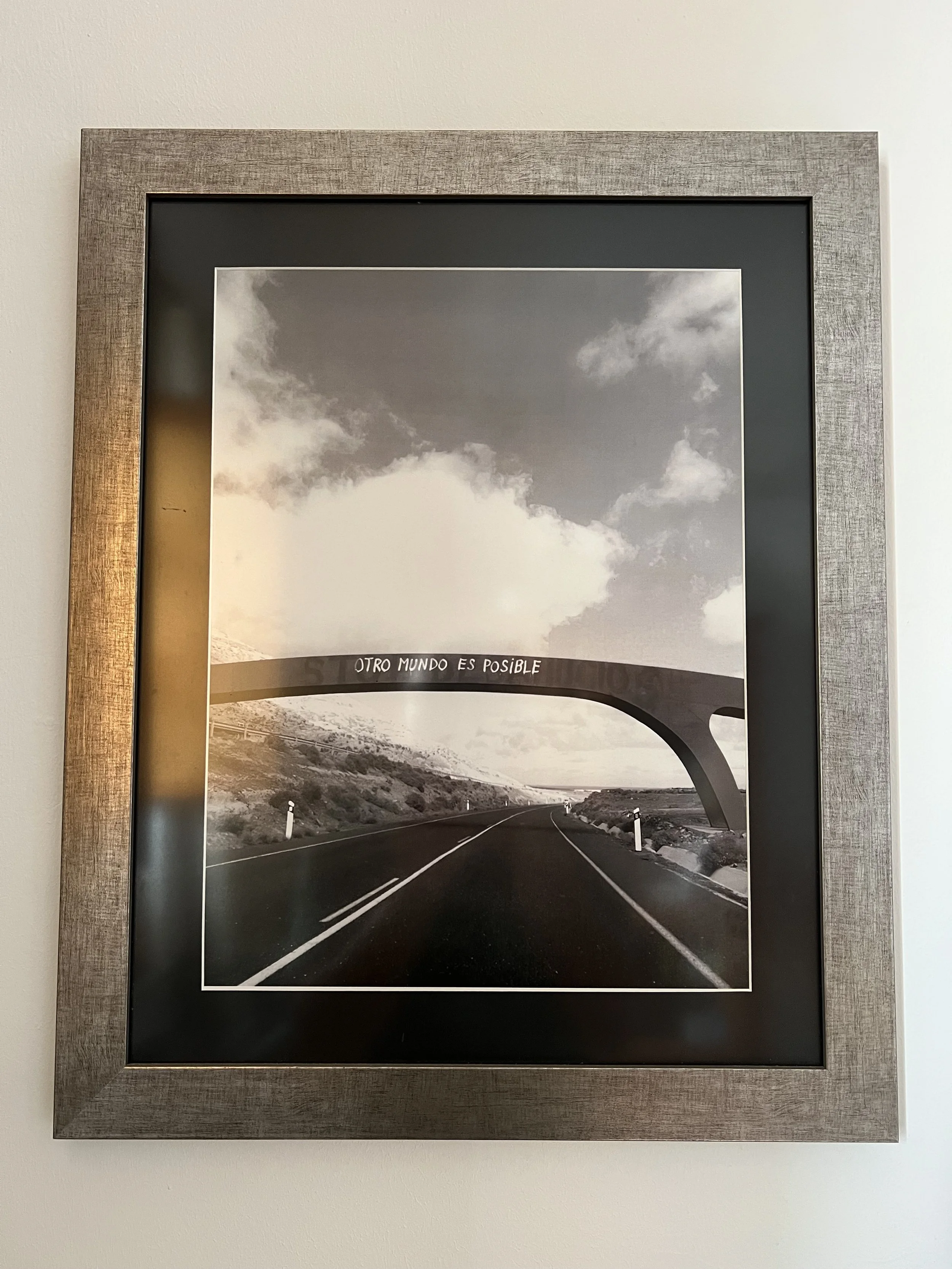
We took a photograph.
Years later, while renting bicycles during one of our visits, we met a German couple who had been living on the island for some time.
We were talking about Lanzarote and how much we loved the people here.
The woman looked at us and said:
"You will never be a part of them."
Perhaps she was simply describing the world she knew.
And perhaps for many people she was right.
But life had other plans.
Today we live in Guatiza.
In the old house of the village blacksmith.
In a place that most tourists never visit.
Our neighbours bring us vegetables, eggs and homemade wine.
We bake cakes and bread and share them in return.
People stop to chat in the square.
We know the families around us.
And they know us.
Most importantly, Loli is no longer a restaurant owner we once met by chance.
She is our friend.
Part of our family.
And we are part of hers.
The graffiti has long disappeared.
Someone painted over it years ago.
The bridge remains.
The photograph remains.
It still hangs on the wall of our home.
And every time we look at it, we are reminded that the message turned out to be true.
The neighbour with the key.
The paella.
The strange conversations that somehow always worked.
The language we learned without planning to.
The friendships that changed our lives.
The village we now call home.
The world described on that bridge was not a dream.
It was real.
We just hadn't discovered it yet.
Otro Mundo es Posible.
We know.
We have been living in it for the last fifteen years.