

Lanzarote Weather: What It Actually Feels Like Month by Month
Weather statistics tell you that Lanzarote is warm, dry and sunny for most of the year.
All of that is true.
But averages don't tell you what you actually want to know when you're packing a suitcase.
Will it feel warm enough to sit outside in January? Is July unbearably hot? When is the ocean warmest? Is Lanzarote really windy? Do you need a jacket in the evening? And why can the weather at your accommodation feel completely different from what you experienced twenty minutes earlier?
Lanzarote's weather is remarkably consistent by European standards.
Its feel, however, changes much more through the year than the temperature charts suggest.
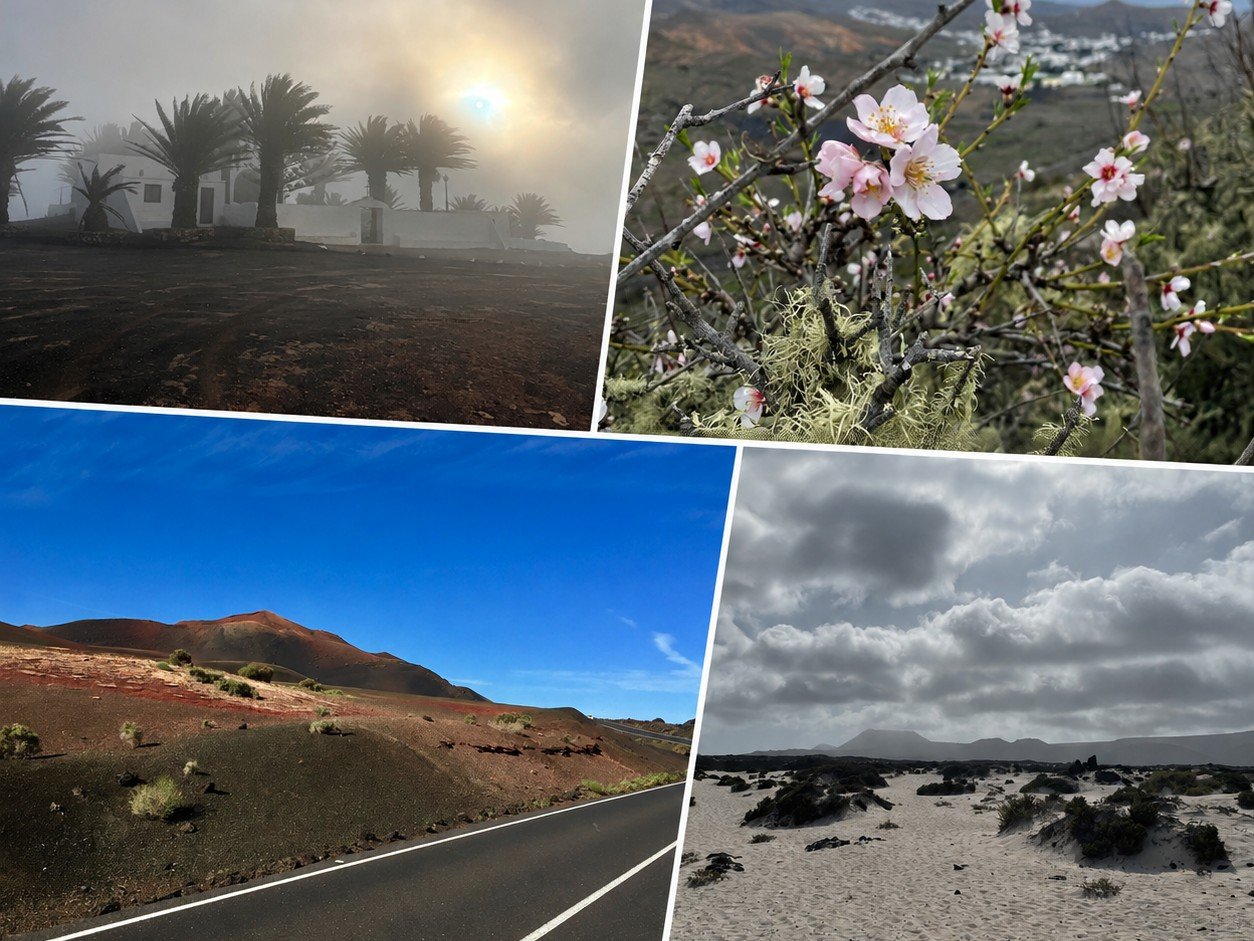
Lanzarote surprisingly has different seasons
JANUARY — WINTER, BUT NOT AS MOST OF EUROPE KNOWS IT
January is one of the months when the difference between the temperature on your phone and the temperature you feel becomes most obvious.
In sunshine and out of the wind, daytime conditions can feel beautifully warm. Sitting outside for lunch or spending an afternoon by a sheltered pool can be entirely realistic.
Then the sun disappears, the wind picks up, or evening arrives — and suddenly you are looking for a jumper.
This is Lanzarote winter.
Not cold in the northern-European sense, but not guaranteed beach weather every hour of every day either.
For walking, hiking, cycling and exploring the island, it can be excellent.
FEBRUARY — SPRING CAN ARRIVE EARLY
February remains winter, but the island can already produce days that feel distinctly springlike.
There can still be cooler or unsettled periods, and evenings remain noticeably cooler than in summer.
But when the sun is out and the wind is light, daytime temperatures can feel considerably warmer than the numbers suggest.
This is also a month when sheltered outdoor spaces really matter.
A terrace protected from the wind can feel like another season compared with an exposed one.
MARCH — ONE OF THE GREAT OUTDOOR MONTHS
By March the days are getting longer and the sun is becoming stronger.
For active holidays, this can be a wonderful time.
Walking, cycling and exploring volcanic landscapes are comfortable because the intense summer heat has not arrived.
You may still want another layer after sunset, particularly in exposed or rural locations.
During the day, however, Lanzarote increasingly begins to feel like the warm-weather destination people imagine.
APRIL — WARMER DAYS, COOL ATLANTIC
April often feels unmistakably like spring moving towards summer.
Sunshine can be strong, afternoons pleasantly warm and evenings increasingly comfortable.
The Atlantic, however, takes longer to warm.
This is an important Lanzarote principle: air temperature and sea temperature do not move together at the same speed.
A hot-looking day does not necessarily mean warm water.
If swimming is central to your holiday, this distinction matters.
MAY — A QUIET SWEET SPOT
May is one of those months that can quietly deliver almost everything.
The days are long, rainfall is unusual, temperatures are warm without usually becoming oppressive, and the island has not yet reached the busier summer holiday period.
For people who want to combine beaches with hiking, cycling, restaurants and exploring, May can be particularly attractive.
The trade winds are part of Lanzarote's climate, however, and a warm May day can still be breezy.
Which brings us to something worth understanding.
THE WIND IS PART OF LANZAROTE
People often ask: Is Lanzarote windy?
Yes.
But that answer is almost useless without context.
The north-easterly trade winds are part of the island's climate and one of the reasons extreme heat is less common than you might expect at this latitude.
Wind also varies by location, terrain and exposure.
One terrace can be breezy while another, protected by walls or a traditional zoco, feels completely calm.
One beach can be uncomfortable while another part of the coast is sheltered.
This is why local weather in Lanzarote is not simply about looking at the wind-speed number on an app.
You learn to ask another question:
Where will I be out of it?
JUNE — SUMMER WITHOUT THE PEAK HEAT
June brings long days, strong sunshine and reliably warm conditions.
The Atlantic is gradually warming, evenings become easier and outdoor living starts extending naturally into the night.
It can also be windy.
For windsurfing and other wind-dependent sports, that is part of the attraction. For somebody imagining perfectly still beach days every afternoon, it can be a surprise.
Sun protection becomes essential.
The breeze can make you forget how strong the sun actually is.
JULY — SUN, WIND AND LONG DAYS
July is firmly summer.
Rain is extremely unusual, days are long and warm, and the island has a distinctly different rhythm.
But Lanzarote does not normally feel like the enclosed heat of a continental Mediterranean city.
The Atlantic and trade winds moderate the temperature.
That doesn't mean heatwaves cannot happen. When hot air arrives from the Sahara, temperatures can rise sharply and dust can reduce visibility — a phenomenon known throughout the Canary Islands as calima.
Most of the time, however, July is characterised as much by sun and wind as by heat.
AUGUST — THE WARMEST VERSION OF LANZAROTE
August is generally among the hottest periods of the year.
The ocean has had months to warm, nights are milder and swimming becomes increasingly attractive.
This is when midday hiking across exposed volcanic terrain becomes considerably less appealing.
If you want to walk, early morning becomes your friend.
It is also peak European holiday season, so weather is not the only factor to consider when choosing August.
SEPTEMBER — PERHAPS LANZAROTE'S MOST UNDERRATED MONTH
September deserves attention.
The intense European school-holiday period begins to subside, the ocean is warm, days remain hot and evenings are comfortable.
Wind can also become less dominant than during parts of summer.
For swimming and outdoor living, September can be superb.
It is one of the months when Lanzarote feels genuinely summery without necessarily carrying the same holiday-season intensity as August.
OCTOBER — SUMMER DOESN'T LEAVE QUICKLY
October can surprise first-time visitors.
Much of Europe has moved decisively into autumn, while Lanzarote can still feel like summer.
The sea retains much of its accumulated warmth, daytime conditions are often excellent and evenings remain pleasant.
There is a slightly greater possibility of unsettled weather as autumn develops, but long periods of warm sunshine remain entirely normal.
For visitors wanting warmth without high-summer conditions, October can be one of the island's most attractive months.
NOVEMBER — THE RETURN OF CONTRAST
November begins the transition back towards the Lanzarote winter.
There are still plenty of warm, sunny days.
But the difference between sunshine and shade becomes noticeable again. Evenings cool down. Weather systems become somewhat more possible.
This is when you start appreciating that extra layer in your suitcase.
It is also when Lanzarote's climate begins to show one of its greatest advantages: while much of Europe moves indoors, life here can still happen outside for much of the day.
DECEMBER — WINTER SUN, NOT GUARANTEED SUMMER
December is one of the months most misunderstood by visitors.
If you arrive expecting August in December, Lanzarote may disappoint you.
If you arrive wanting sunlight, outdoor lunches, walking, cycling and the possibility of spending warm afternoons beside a sheltered pool while northern Europe is in winter, it can feel extraordinary.
There can be clouds.
There can be rain.
There can be windy days.
And there can also be afternoons when you sit outside in a T-shirt wondering how this can possibly be December.
Both are Lanzarote.
NORTH VERSUS SOUTH — DOES IT REALLY MATTER?
Yes, but perhaps not as dramatically as some travel advice suggests.
The south of Lanzarote generally has a reputation for being sunnier and more sheltered, which helps explain the development of the major resort areas there.
Northern Lanzarote can experience more cloud and greater exposure to the trade winds.
But Lanzarote is small.
Weather can change surprisingly quickly as you move around the island, and local topography matters enormously.
A cloudy morning in the north does not mean a cloudy day everywhere.
Nor does a sunny forecast tell you whether your particular terrace will be protected from the wind.
Microclimate matters.
WHAT SHOULD YOU PACK?
Even in Lanzarote, layers are useful.
In winter, bring something warm enough for evenings and windy days.
In summer, lightweight clothing dominates, but a light layer can still be useful after dark or in particularly windy locations.
Good sun protection is essential throughout the year.
And if you plan to walk across volcanic terrain, proper footwear matters far more than whether your outfit looks suitably tropical.
SO WHEN IS THE WEATHER BEST IN LANZAROTE?
There isn't one answer.
If you want the warmest ocean and reliably hot conditions, late summer and early autumn have obvious advantages.
If you want to hike, cycle and explore without summer heat, winter and spring can be fantastic.
If you want warmth, long days and a balance between beaches and activity, late spring can be hard to beat.
And if you simply want to escape a northern-European winter, Lanzarote can deliver something much more valuable than guaranteed heat:
the possibility of living outside again.
That is why weather averages only tell half the story.
Lanzarote doesn't have one perfect season.
It has different versions of itself throughout the year.
OME note: If weather is deciding when you should travel rather than simply what to pack, read When Is the Best Time to Visit Lanzarote? It Depends on What You Want to Do next.